The Library The Fool's Journey
The Fool's Journey
Read in order, the twenty-two cards of the Major Arcana tell one story. The Fool sets out with nothing, meets each of the other twenty-one in turn, and is changed by every one — until the road comes round at the World and the journey begins again.
When a major card turns up in a reading, it helps to know where it sits on this road: what the Fool has already learned by then, and what is still ahead.
Setting out
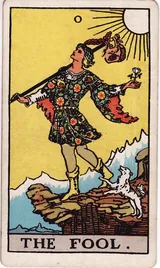
The Fool at zero: the traveller before the first step, carrying nothing but willingness.
0 The Fool
The Fool is the traveller, and the whole Major Arcana is the road. At zero the Fool has no history, no lessons and nothing to lose — only a bag, a dog, and a step off the edge of what is known. Every card that follows is someone or something the Fool meets, and each one takes a little innocence and gives back a little understanding. By the end the Fool arrives at the World and becomes the zero again, with the whole journey folded inside. Every major card in a reading is a stop on this road, and the Fool is always the one walking it.
The outer world
The Magician through the Chariot. Learning to use will, to make choices, to face authority, to love, and to move through the world with purpose.
I The Magician
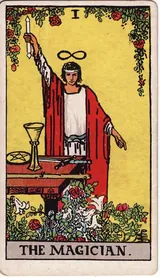
The first thing the Fool meets is proof that will works. The Magician stands with all four suits on the table and shows the Fool that intention, pointed carefully, can turn what is possible into what is real. It is the first lesson and the most intoxicating: you can do things. What the Magician does not yet teach is what is worth doing, or what you cannot control — those come later. The Fool leaves this card with tools in hand and a new confidence that has not been tested.
II The High Priestess
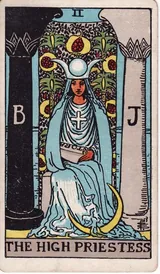
Having learned to act, the Fool is sent straight to the one who does not. The High Priestess sits between two pillars and keeps what cannot be said. Her lesson is the opposite of the Magician's: that there is knowledge you cannot seize, only receive, and that some of it arrives as intuition rather than argument. The Fool learns to stop talking long enough to hear something. It is the first hint that the road has an inside as well as an outside, and that the inside will matter more before the journey is done.
III The Empress
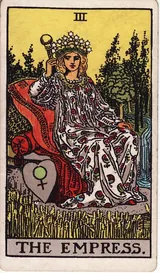
The Empress is the Fool's first experience of abundance — the world as a garden rather than a problem. Here the Fool learns that things grow when they are cared for, that the body and the senses are not distractions from the path but part of it, and that creation takes time and nourishment rather than a single act of will. After the Magician's doing and the Priestess's knowing, the Empress teaches tending. The Fool leaves fed, and with the first sense of what it means to be responsible for something alive.
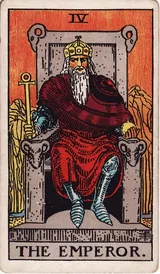
IV The Emperor
Abundance needs a boundary or it overruns itself, and the Emperor is where the Fool meets structure. Rules, order, protection, authority — the Emperor shows that a stable world is built and held, not simply given. The Fool may chafe here; the Emperor is the first figure who says no. But the lesson is real: freedom without form goes nowhere, and someone has to decide where the walls go. The Fool leaves understanding that power is responsibility, and that one day the Fool will have to govern something too, starting with themselves.
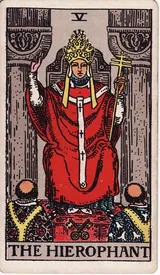
V The Hierophant
Beyond the rule of one king lies the inheritance of many: tradition, teaching, belief handed down. The Hierophant gives the Fool a lineage — a community that has asked these questions before, and answers that were hard-won by others. The lesson is humility and belonging. It is also the first place the Fool may be asked to conform, and part of the journey is learning which of these inherited answers to keep. The Fool leaves with a map drawn by other hands, useful and incomplete.
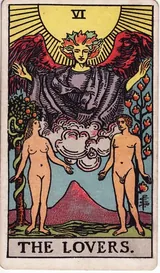
VI The Lovers
At the Lovers the Fool must choose, and the choice is personal for the first time. Until now the Fool has been taught; here the Fool has to decide what they value, and bind themselves to it — a person, a path, a truth about who they are. The lesson is that love and choice are the same act: to choose something is to let go of everything else. The Fool leaves no longer a student of other people's answers but someone with a commitment of their own.
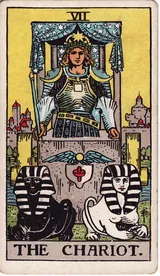
VII The Chariot
With will, knowledge, care, order, tradition and a chosen commitment, the Fool is ready to move. The Chariot is the first victory: opposing forces held together by discipline and driven in one direction. It is the high point of the outer journey — the Fool succeeds in the world. But the Chariot's triumph is won by control, and control is where the next stage of the road begins to push back. The Fool leaves having conquered what is outside; what is inside has not yet been met.
The inner work
Strength through Temperance. Turning within to face the shadow, to surrender to higher forces, to integrate opposites, and to seek wisdom beyond the ego.
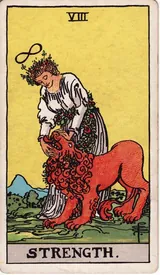
VIII Strength
The second stage of the journey turns inward, and it opens gently. Strength shows the Fool a different kind of power from the Chariot's: not the reins, but a hand resting on a lion's jaw. What the Fool must now master is not the world but their own appetites, fears and anger, and force does not work on those. The lesson is patience and compassion turned toward the wild parts of the self. The Fool leaves stronger for having stopped fighting.
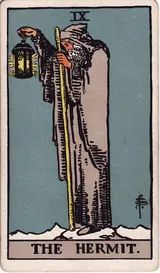
IX The Hermit
Having made peace with the beast, the Fool walks away from the crowd. The Hermit climbs alone with a lantern that lights only the next step, and the Fool learns the value of solitude — of withdrawing from other voices long enough to find their own. The answers here are not on anyone's map. The lesson is that wisdom is found, not given, and that the search is lonely by design. The Fool leaves carrying a small light of their own, enough to go further in.
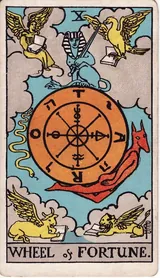
X Wheel of Fortune
Out of the Hermit's stillness, the Fool meets the turning of the world. The Wheel shows that fortune rises and falls regardless of merit, that cycles repeat, and that no position — high or low — is permanent. For a traveller who has been learning to master things, this is a humbling lesson: some of life simply happens. The Fool learns to read the turning rather than resist it, and to find the still centre of the wheel. The Fool leaves understanding luck, and its limits.
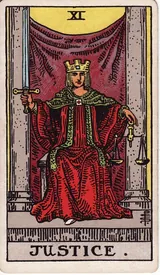
XI Justice
If the Wheel is chance, Justice is consequence. The Fool stands before a clear-eyed judge and learns that actions have weight, that every choice made along the road has been recorded, and that fairness requires honesty about oneself. It is the midpoint of the Major Arcana and a moment of balance: what the Fool has done is weighed against what the Fool intended. The lesson is accountability. The Fool leaves having seen themselves accurately, perhaps for the first time.
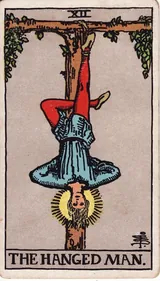
XII The Hanged Man
After being weighed, the Fool is suspended. The Hanged Man hangs upside down by choice, and his face is calm. Here the Fool learns that some things cannot be achieved by effort at all — only by surrender, waiting, and letting the world be seen from a completely different angle. Everything the Fool thought was up turns out to be down. The lesson is sacrifice of a willing kind: giving up control to gain insight. The Fool leaves seeing differently, and ready for what has to end.
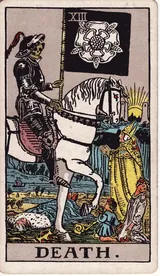
XIII Death
Death is the turning point of the inner journey. Something in the Fool has to end for the road to continue — an old self, an outgrown identity, the version of the Fool that set out. The card is not a threat but a transformation: the harvest that clears the field. The lesson is that change is not optional past a certain point, and that clinging to what has finished only prolongs the grief. The Fool leaves lighter, having let go of who they were.
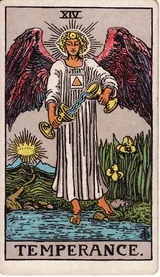
XIV Temperance
After the ending comes the careful work of becoming whole. Temperance pours water between two cups and mixes what seemed opposed — fire and water, spirit and body, the old self and the new. The Fool learns moderation, patience, and the slow alchemy of blending experience into something balanced. It closes the inner stage of the journey: the Fool is integrated, calmer, healed. But healing is not the end of the road, and the hardest meetings are still ahead.
Reckoning and return
The Devil through the World. Breaking the chains of illusion, surviving catastrophe, finding faith, and integrating all experience into wholeness.
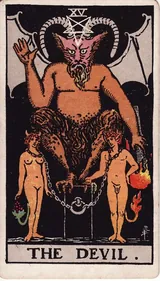
XV The Devil
The final stage begins in shadow. Having become whole, the Fool must face what still binds them: the habits, cravings, fears and bargains that feel like chains but are worn loosely enough to slip off. The Devil's lesson is recognition. Nothing here can be escaped until it is seen for what it is, and the Fool must admit which chains they chose. The Fool leaves knowing their own captivity — which is the only way out of it.
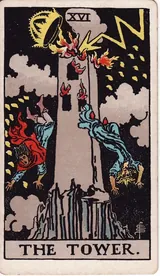
XVI The Tower
Some chains will not come off by choice, so the structure holding them is struck down. The Tower is sudden, violent, and total: every false certainty the Fool built along the road — even the ones that felt like progress — collapses at once. The lesson is that liberation sometimes arrives as catastrophe. What survives the lightning is only what was true. The Fool leaves stripped of illusions, standing in the rubble, and finally free to look up.
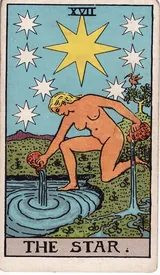
XVII The Star
After the Tower, the night is quiet and clear, and the Fool finds hope. The Star kneels by the water, pouring freely, unashamed and unguarded. Here the Fool learns that after the worst has happened, renewal is possible — not the old life restored, but a truer one beginning. The lesson is faith: the quiet trust that the road still leads somewhere. The Fool leaves healed in a deeper way than Temperance allowed, guided by a distant but steady light.
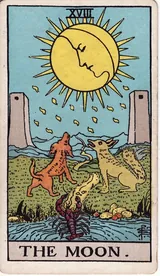
XVIII The Moon
The Star's light is faint, and under the Moon the path runs between shadows. The Fool must travel through confusion, dream and fear, where nothing is quite what it appears and the instincts that were quieted long ago rise up again. The lesson is to keep walking without certainty, trusting intuition where reason cannot see. This is the last test of the dark. The Fool leaves having crossed the uncertain country, with the dawn just ahead.
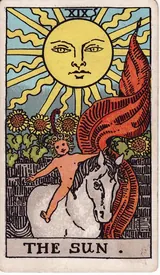
XIX The Sun
Morning arrives, and with it joy. The Sun shows the Fool the world in full light: simple, warm, and clear. After the long night everything is visible and nothing needs to be hidden. The lesson is vitality and plain happiness — the innocence of the Fool's first step, returned, but this time earned. The Fool leaves bright and whole, and ready to be called to account for the whole of the journey.
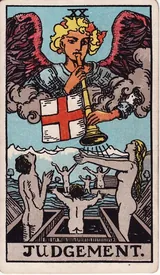
XX Judgement
The trumpet sounds, and the Fool is called to rise. Judgement is an awakening: the Fool looks back over the entire road, forgives what needs forgiving, and hears the calling that the journey was preparing them for. The lesson is rebirth through reckoning — not a verdict from outside, but the Fool's own recognition of who they have become. The Fool leaves answering that call, with one threshold left to cross.
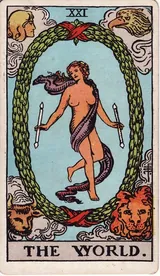
XXI The World
The World is the journey complete. The Fool dances inside the wreath, every lesson of the road integrated into a single whole: will and receptivity, structure and freedom, loss and renewal. The lesson is fulfilment — the sense that the cycle has come round and nothing was wasted. And the World's gift is that it opens back onto the Fool: a completed journey is only the zero of the next one. The traveller steps off a new edge, carrying everything.